
Best Decking Materials and Products to Use in Allendale, MI
Best Decking Materials and Products to Use in Allendale, MI
If you are researching the best decking materials in Allendale, MI, do not just focus on the deck boards. A deck’s long-term performance comes from the full system underneath it and the details most people never see after the job is done.
In a place like Allendale, where decks deal with rain, snow, freeze-thaw cycles, humidity swings, and wet spring and fall conditions, product choice matters. West Michigan weather is hard on exterior structures, which is exactly why the materials and build methods you use up front matter so much over time.
This guide covers the products and details that homeowners and deck builders in Allendale should seriously consider when building a deck the right way.
Start with the framing, not just the decking
A lot of people shop decks by color, board style, or railing look. That makes sense because those are the parts you see every day. But if you want a deck that lasts, the real conversation starts with the structure.
The best-looking deck in the neighborhood will still become a problem if moisture gets into the framing, the posts are not protected, or critical connections were done the cheap or outdated way. Simpson Strong-Tie’s deck guidance emphasizes code-compliant, secure beam-to-post and deck framing connections because those details play a major role in long-term performance and safety.
1. Joist tape is one of the smartest products you can add
If a builder skips joist tape, that is a red flag.
Joist tape helps protect the tops of joists from moisture intrusion. Water sits on top of framing members, especially where fasteners penetrate the wood, and over time that repeated wetting is what starts wearing down the structure. Above-joist protection systems and joist protection tapes are specifically marketed to reduce moisture exposure on deck framing because repeated wetting is one of the main causes of premature deterioration.
For us, joist tape is not some fancy upgrade. It is one of those products that simply makes sense, especially in Michigan.
It matters even more on stairs. If you look at what fails first on a lot of decks, it is often the stair area. That is because stairs have so many exposed cuts, extra connections, and more places for water to sit. That is why protecting stair framing matters so much.
2. Every treated wood cut should get cut-end sealer
This is another detail that gets skipped all the time, and it should not.
Whenever pressure-treated lumber is cut, drilled, or notched, the exposed wood fiber should be field-treated or sealed according to treated wood guidance so the protective treatment is restored at the cut area. That is especially important on end cuts, notches, and stair framing where moisture exposure is constant.
That is why every exposed treated cut should get cut-end sealer.
Why does this matter so much? Because the places that fail first are usually the places that were most exposed. Stair stringers, stair framing, and other heavily cut areas take a beating. We seal those cuts because that is where water gets in fastest.
On many builds, we also tape the stair stringers, which gives them even more protection. You usually are not wrapping every exposed end of a beam in tape, but on horizontal framing surfaces and stair components, that added protection can make a big difference.
3. Use 6×6 posts, not undersized posts
If you want a deck to feel solid, use real posts.
For deck structures, 6×6 posts are the better standard for a stronger, heavier-duty feel. Homeowners may not know the technical side of a frame, but they absolutely notice when a deck feels sturdy and substantial underfoot.
Just as important is how the beam meets the post.
4. Avoid outdated post-to-beam methods
There are still builders using older post-and-beam methods that are not what most homeowners should want on a modern deck.
A better approach is a true post-to-beam setup where the load path is direct and the connection is properly handled. Simpson Strong-Tie’s deck resources emphasize using tested metal connectors for post-to-beam connections, and current guidance favors properly engineered connection methods over improvised field-built solutions.
For our builds, that usually means one of two updated approaches:
- a properly notched 6×6 post, or
- the beam bearing directly on top of the post with the proper Simpson Strong-Tie hardware
That gives you a cleaner, stronger, more current way to build than the old-school methods some guys still use.
5. Post protection matters too: use post savers
One of the most overlooked failure points on a deck is the lower portion of the post, right where it deals with trapped moisture near the ground.
That is why post protection matters. Post savers are there to help protect the vulnerable lower section of the post, especially where repeated moisture exposure can shorten lifespan over time.
For Michigan decks, this is one more example of a small product choice that can help protect the structure where it is most vulnerable.
6. For the deck surface, PVC and composite are the modern standard
When homeowners in Allendale are comparing deck surfaces, the biggest decision is usually wood vs. low-maintenance decking.
Pressure-treated wood still has its place, especially for more budget-driven projects. But for homeowners who want less maintenance and a more finished look, composite and PVC products are usually the better long-term choice.
We use Clubhouse PVC decking on our PVC builds. Clubhouse markets its decking as designed to handle UV, rain, and humidity while staying low-maintenance, which makes sense for a Michigan climate where decks see a lot of weather.
That said, this is not just about one brand. In general, quality PVC or composite decking is a smart move if you want:
- lower maintenance
- no regular staining cycle
- a cleaner finished look
- better long-term appearance retention than basic wood decking
7. Picture framing gives the deck a finished look
A lot of decks are technically functional but still look unfinished.
That is where picture framing comes in.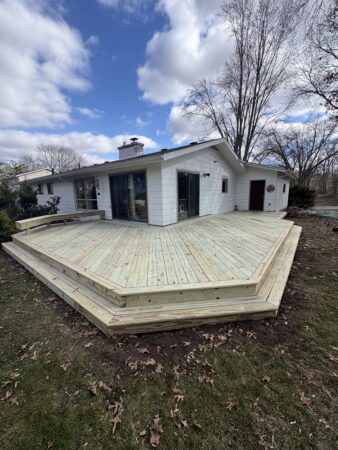
Picture framing the deck border gives the deck a clean perimeter and makes the finished product look intentional instead of basic. On composite and PVC decks, we consider this standard. Sometimes the border matches the main deck color for a seamless look. Other times, homeowners choose a contrasting color to make the frame stand out.
Either way, it is one of the best visual upgrades you can make.
8. Fascia should not be optional
For some reason, some builders still skip fascia, even though it makes a major difference in the final appearance.
Fascia helps cover the exposed band area and gives the deck a more complete, professional finish. Without it, a deck can look incomplete even when the rest of the build is done well.
We treat fascia as standard because finishing details matter. A deck should not just be structurally sound. It should also look complete from every angle.
9. Aluminum hand railing is the best overall railing choice
When it comes to railing, aluminum is the clear choice for most composite and PVC decks.
Composite railing can break down over time, and a lot of homeowners end up preferring the cleaner look and lower maintenance of aluminum anyway. Aluminum railing is widely used because it is corrosion-resistant, low-maintenance, and available in code-compliant systems built for exterior use.
We use Ultralox aluminum railing. Ultralox describes its systems as powder-coated aluminum, rust-free, maintenance-friendly, and code-compliant, which is exactly what most homeowners want on a modern deck.
On wood decks, a wood railing can still make sense. But on composite or PVC builds, aluminum is usually the way to go.
What homeowners in Allendale should really be looking for
If you are comparing deck builders or researching products yourself, do not just ask what deck board brand they use.
Ask questions like:
- Do you tape the joists?
- Do you seal every treated cut?
- Are you using 6×6 posts?
- How are your beams attached to the posts?
- Are the posts protected at the bottom?
- Are you picture framing the deck?
- Are you finishing it with fascia?
- What railing system are you using, and why?
Those questions tell you a lot more about build quality than a color sample ever will.
The best decking materials in Allendale, MI are the ones that protect the whole deck system
The best deck in Allendale is not just about choosing a nice board. It is about building the entire system to hold up in West Michigan conditions.
That means using products and methods like:
- joist tape
- cut-end sealer
- 6×6 posts
- updated post-to-beam connections
- post protection
- quality PVC or composite decking
- picture framing
- fascia
- aluminum railing
Those are the kinds of details that separate a deck that simply looks good on day one from a deck that still performs and looks right years later.
If you are planning a deck in Allendale and want help comparing materials, layout options, and the right product choices for your home, schedule an in-home quote and we’ll walk you through it.